Methods of correcting facial nerve palsy:
- Hemiface lift using fascia lata
- Selective neurectomy of facial nerve branches on the healthy side
- Reconstruction using the temporalis or masseter muscle
- Cross-facial nerve graft
- Free vascularised muscle transfer to the paralysed side
- Correction of facial asymmetry with Aptos threads
What are Aptos threads?
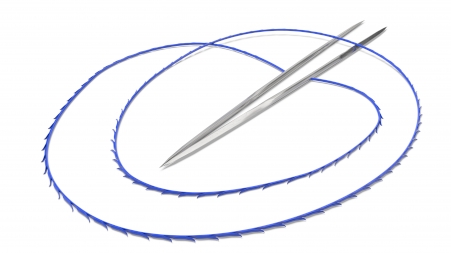
Aptos threads have been used for over 20 years to correct skin changes resulting from ageing. Aptos thread techniques are primarily used to counteract ptosis, i.e. sagging (APTOS stands for anti-ptosis - against sagging). The creators of Aptos threads are Georgian plastic surgeons - Dr Marlen Sulamanidze and his sons Dr Konstantin Sulamanidze and George Sulamanidze. Over the years, they have developed dedicated products - threads designed for implantation during specific procedures, and have also built a training system for implantation methods. As a rule, polypropylene non-absorbable barbed threads are used for correcting facial asymmetry due to nerve palsy, which effectively and permanently support sagging tissues. When appropriate, polycaprolactone threads (a combination of caprolactone and lactic acid) may also be used to enhance the aesthetic result. These are absorbable threads that lift tissues while also stimulating new collagen production, and therefore have regenerative properties.
The methods of correcting tissue sagging using Aptos threads are patented and used by plastic surgeons worldwide.
Indications and qualification:
- Post-facial nerve palsy condition with no prognoseis for spontaneous improvement (2 years after injury)
- Electromyographic (EMG) examination confirming complete damage with no signs of regeneration
- Clinical examination
- Patient's willingness to undergo the procedure
Procedure:
The procedure is performed under local anaesthesia and is painless. After deciding on the number and type of threads to be used, the specialist draws the thread passage vectors on the patient's face. Thanks to the appropriate structural material of individual threads from the Aptos range, the implantation can be individually tailored to each case (tissue sagging occurs in one or more zones of the face, but on one side, resulting in impairment of both function and aesthetics of individual parts of that side of the face). The threads are inserted through small punctures made with a dedicated implantation needle. Once the threads are placed in the correct position, the barbs fix the tissues in the desired position. The procedure is short (40 min.) and minimally traumatic.
What does the procedure look like?
Before/after results

Procedure: Dr T. Witwicki, result after 7 months

Procedure: Dr K. Sulamanidze, result after 2 years
Post-operative recommendations:
- Apply cold compresses to the face (ice/ice packs)
- If pain persists, take analgesics for 2-3 days
- Do not apply makeup for at least 24 hours after the procedure
- Sleep face up, in a semi-sitting position for 3-5 nights after the procedure
- Wash the face gently, without rubbing or massaging for 5-7 days
- Avoid vigorous chewing movements for approximately 2-3 weeks after the procedure
- Avoid facial and neck massage for one month after the procedure
- Avoid direct sun exposure for approximately 2 weeks after the procedure
- Avoid sports and exercise for approximately 2 weeks after the procedure
- Do not use a sauna for approximately 3 weeks after the procedure
- Avoid oral surgery for up to 3 weeks after the procedure
- If necessary, the specialist will prescribe an antibiotic (if there is a risk of infection)
Frequently asked questions about Aptos thread procedures:
Is the Aptos thread correction procedure for facial nerve palsy painful?
No, the procedure is performed under local anaesthesia and no pain is felt during it. The procedure leaves no scars, is short and requires minimal recovery time.
What happens immediately after the Aptos thread procedure?
As with other similar procedures, there is a risk of side effects, although not all patients experience them.
Possible side effects of Aptos thread lifting include:
- post-procedure pain
- swelling
- temporary asymmetry
- transient wrinkling or dimple formation
- short-term occurrence of haematomas or bruising
- inflammation
All side effects should usually subside within a few days after the procedure.
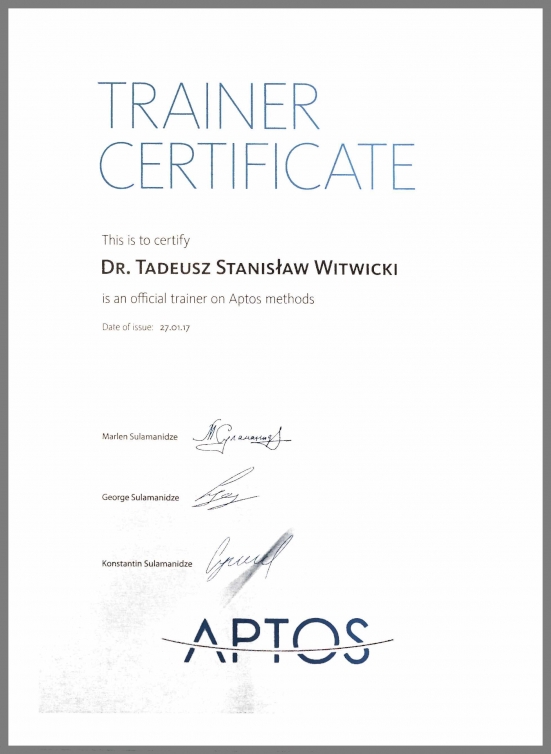
Dr Tadeusz Witwicki, MD, PhD is an International Aptos Trainer