Indications for the procedure
- mild tissue sagging
- inability to undergo an extensive procedure under general anesthesia
Before the procedure:
Before undergoing the procedure, the patient must attend a consultation during which the specialist will answer all questions, including how the procedure will be performed. Blood-thinning medications (e.g. aspirin) must not be taken for 10 days before the planned procedure.
Type of anesthesia:
Local or intravenous anesthesia (upon request).
Duration of the procedure:
Depending on the area: 40 to 60 minutes.
Course of the procedure:
After marking the thread paths, under local anesthesia, a puncture incision is made with a needle and the threads are introduced into the subcutaneous layer.
Postoperative recommendations:
- apply cold compresses to the face (ice/ice packs)
- if pain persists, take pain medication for 2-3 days
- do not apply makeup for at least 24 hours after the procedure
- sleep face up, in a semi-sitting position for 3-5 nights after the procedure
- wash the face gently, without rubbing or massaging for 5-7 days
- avoid strong chewing movements for approx. 2 weeks after the procedure
- avoid wide-range head and neck movements for approx. 2 weeks after the procedure
- avoid face and neck massage for one month after the procedure
- avoid direct sun exposure for approx. 2 weeks after the procedure
- avoid sports and exercise for approx. 2 weeks after the procedure
- do not use a sauna for approx. 3 weeks after the procedure
- avoid oral surgery for up to 3 weeks after the procedure
- if necessary, the specialist will prescribe antibiotics (if there is a risk of infection)
Recovery time:
Swelling usually persists for several days. A pulling sensation may last for up to several weeks, depending on the number and type of threads.
Frequently asked questions:
Is the Aptos thread lift procedure painful?
No, the procedure is performed under local anesthesia and no pain is felt during the procedure. The procedure does not leave scars, is short, and requires minimal recovery.
What are the contraindications for the Aptos thread lift?
- allergy to plastic, biomaterial, non-absorbable fillers
- active acne or skin infection
- predisposition to keloids
- autoimmune diseases: scleroderma, sarcoidosis, amyloidosis
- taking anticoagulant medications: e.g. heparin, aspirin
- hemophilia
- hypertension (grade II and III)
- serious medical conditions
- neurological and psychological disorders
- pregnancy, breastfeeding
- chemotherapy
What happens right after the Aptos thread lift?
As with other similar procedures, there is a risk of side effects, although not all patients experience them.
Possible side effects of the Aptos thread lift include:
- post-procedure pain
- swelling
- temporary asymmetry
- transient wrinkling or dimple formation
- short-term bruising or hematomas
- inflammation
All side effects should typically subside within a few days after the procedure.
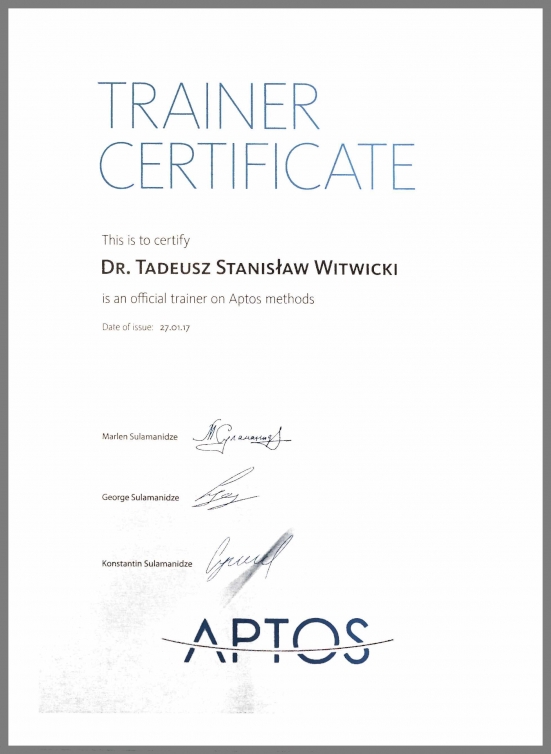
Dr. Tadeusz Witwicki, MD, PhD is an International Aptos Trainer